Updated by
AI Engineer Paris 2026: What the Conference Reveals About AI Jobs in France
Published: September 2026
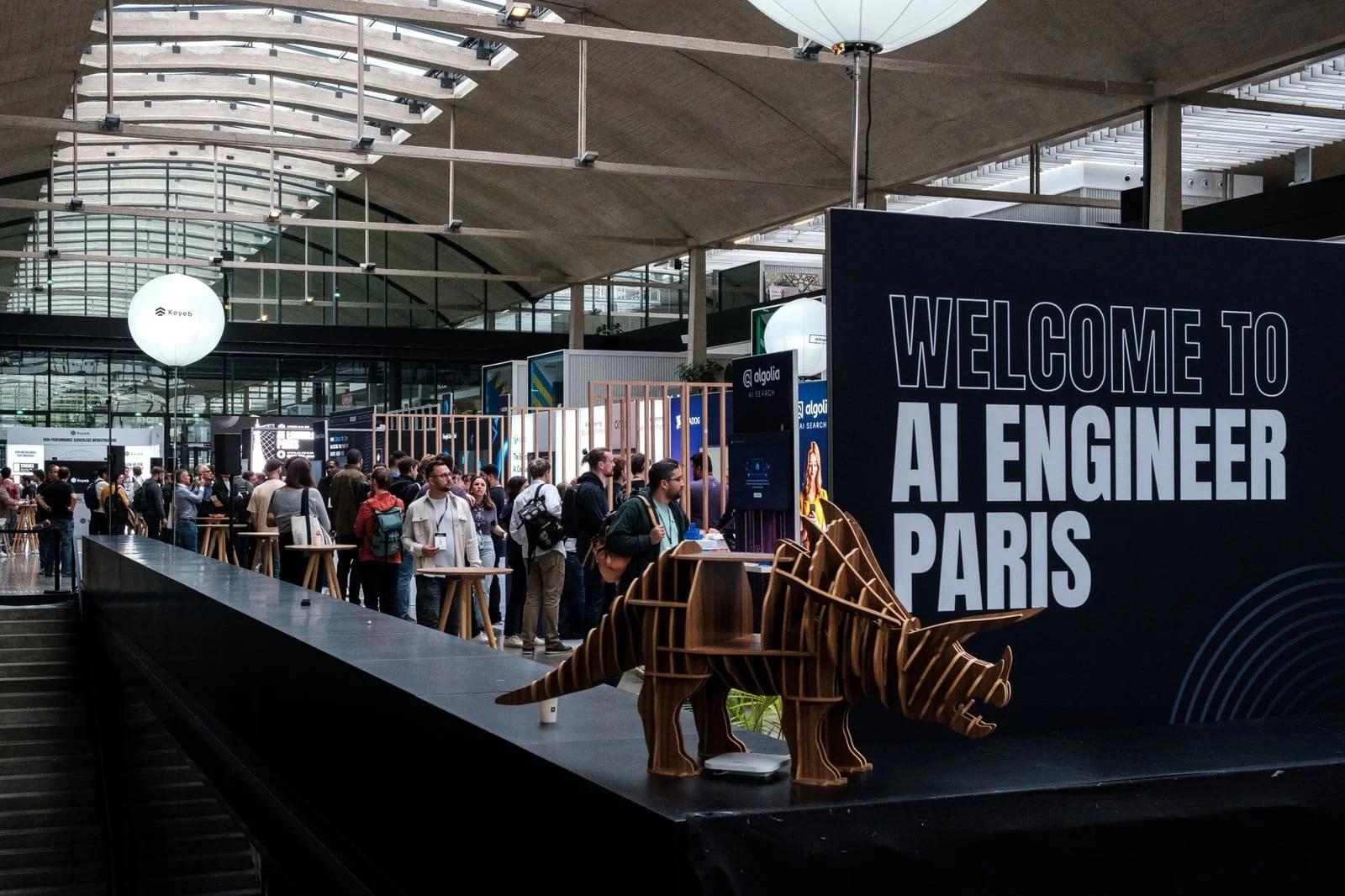
Paris has spent the last few years building one of Europe’s most visible AI ecosystems. This week, that ecosystem is on display at AI Engineer Paris 2026, a two-day technical conference at STATION F bringing together AI engineers, CTOs, founders, researchers, developer-relations leaders and companies building production AI systems.
Taking place on 23–24 September 2026, the event combines keynotes, technical sessions, workshops, fireside chats, an expo area and networking. It is presented as the second Paris edition of AI Engineer and is expected to bring together around 1,000 participants.
For candidates and employers, the event is more than a conference. Its agenda offers a useful snapshot of the skills, technical domains and company types shaping AI hiring in France and across Europe.
A conference for production AI
AI Engineer positions its events around the people building with AI: software engineers, technical founders and AI architects. That focus matters.
The AI job market has moved well beyond experimentation with chatbots and prototypes. Employers increasingly need professionals who can build reliable systems: deploy models, work with data, manage inference, evaluate outputs, secure AI products, integrate tools into business workflows and create useful applications for real users.
The Paris programme reflects this shift through four core technical themes:
Theme | What it covers | Roles increasingly associated with it |
|---|---|---|
Agentic engineering and agents in production | AI agents, tool use, workflows, coding agents and reliable execution | Applied AI Engineer, Agent Engineer, Full-stack AI Engineer |
Inference and AI infrastructure | Model serving, GPUs, performance, cost, scaling and deployment | ML Infrastructure Engineer, MLOps Engineer, Platform Engineer |
Voice and real-time AI | Speech systems, low-latency models and multimodal interaction | Speech ML Engineer, Applied Scientist, AI Product Engineer |
Research and frontier AI | New model capabilities, evaluation, post-training and research-to-product work | Research Engineer, AI Scientist, ML Engineer |
The event’s focus on production systems is a strong signal for job seekers: knowing how to call an API is useful, but employers increasingly value people who can make AI systems robust, observable, safe and commercially useful.
The speakers and their companies
The agenda brings together speakers from French AI leaders, global model providers, cloud and infrastructure companies, developer platforms, research organisations and enterprise technology businesses.
Mistral AI: models, agents and infrastructure
Mistral AI is central to the event’s Paris identity. The company is involved in presenting the conference and contributes speakers across several technical tracks.
Lélio Renard Lavaud, VP of Engineering at Mistral AI, is scheduled to speak on “Agentic Engineering & Agents in Production.” The topic reflects the growing importance of AI systems that do more than generate text: systems that can use tools, follow workflows, manage context and complete tasks with appropriate reliability.
Mistral is also represented by:
Jen Person, opening the conference on behalf of Mistral;
Yann Leger, appearing alongside NVIDIA’s Adolf Hohl for a session on building infrastructure for the next generation of AI;
Maxime Villeger, participating in an agentic-engineering session with Microsoft’s Trupti Parkar and Ninad Joshi.
For job seekers, Mistral’s presence underlines the demand for ML infrastructure, research software, applied AI, product engineering, solutions work and AI-platform roles—not only research-scientist positions.
NVIDIA: the infrastructure behind modern AI
NVIDIA appears across the programme through speakers and workshops focused on inference and AI infrastructure.
Ron Kahn and Dan Feigin are scheduled to lead a workshop, while Adolf Hohl joins Mistral’s Yann Leger to discuss infrastructure for next-generation AI. Maxime Pariente of NVIDIA also appears in the programme alongside Yannis Tevissen from Moments Lab.
NVIDIA’s participation reflects a practical reality of the AI jobs market: AI is increasingly an infrastructure discipline. The most valuable systems depend on GPUs, high-performance model serving, data pipelines, distributed systems, optimisation and cost control.
This creates demand for professionals with skills in:
GPU and compute infrastructure;
Distributed systems;
Kubernetes, Docker and cloud platforms;
Model serving and inference optimisation;
AI observability and reliability;
Data engineering and MLOps.
Stripe, Microsoft and Notion: AI moves into products
The programme also demonstrates how AI has become a core product and engineering concern for major software companies.
Arielle Le Bail of Stripe is scheduled to speak on agentic engineering and production agents. Stripe’s presence is relevant because payment, financial infrastructure and enterprise software companies are increasingly hiring engineers who can integrate AI into established products while preserving reliability, compliance and user trust.
Microsoft is represented in a joint agentic-engineering session involving Trupti Parkar, together with Mistral’s Maxime Villeger and Ninad Joshi. This type of collaboration illustrates a broader market opportunity: AI professionals need to understand not only models, but also enterprise platforms, cloud ecosystems and customer deployment.
Geoffrey Litt, Design Engineer at Notion, is listed among the conference speakers. His presence points to another important trend: building AI products is not purely a machine-learning task. It also requires product design, human-computer interaction, workflow design and thoughtful user experience.
The relevant career paths include:
AI Product Manager;
Product Engineer;
Full-stack AI Engineer;
Solutions Architect;
Applied AI Engineer;
AI UX and conversational-product designer.
Google, Google DeepMind and Anthropic: frontier research meets engineering
The speaker list includes people from some of the world’s most influential AI research organisations.
Benoit Schillings, VP of Technology at Google DeepMind, is listed as a speaker, alongside Thor Schaeff, a Member of Technical Staff in Developer Experience at Google DeepMind. Averi Kitsch and Prerna Kakkar, both associated with Google, also appear in the event speaker directory.
Thariq Shihipar from Anthropic and its Claude Code ecosystem is also listed among the speakers.
Their presence matters for the French job market because Paris is increasingly connected to the global AI research and developer-tool ecosystem. Candidates do not need to work at a frontier lab to benefit from this trend. The methods and standards emerging from these companies—evaluation, agent reliability, coding workflows, model safety, developer experience and context management—are influencing hiring requirements across start-ups, consultancies and large companies.
Modal, Liquid AI and Sonar: the growing AI infrastructure layer
Several speakers represent companies focused on the systems needed to build, deploy and manage AI applications.
Charles Frye of Modal is scheduled to speak in the inference and AI-infrastructure track. Modal’s presence reflects the growth of serverless and scalable infrastructure for AI workloads.[ai]
Leonie Monigatti of Liquid AI is scheduled in the agentic-engineering track, while Tariq Shaukat, CEO of Sonar, and Sylvain Combe of Sonar are also connected to the event programme.
These companies represent an important employment trend: the AI economy needs platforms, observability, infrastructure, security and developer tooling as much as it needs models.
For candidates, relevant job titles include:
AI Platform Engineer;
ML Infrastructure Engineer;
Inference Engineer;
Developer Relations Engineer;
Solutions Engineer;
Technical Product Manager;
AI Developer Experience Engineer.
Voice and real-time AI are becoming specialist markets
Voice and real-time interaction are also visible in the agenda.
Hervé Bredin from pyannoteAI is scheduled to speak on voice and real-time AI, while Olivier Teboul from Gradium also appears in this track.
This signals opportunity for engineers and researchers with expertise in:
Speech recognition;
Speaker diarisation;
Audio processing;
Real-time inference;
Multimodal AI;
Latency and streaming systems;
Voice-product development.
The market for voice AI is likely to expand as companies build agents for customer support, enterprise search, accessibility, real-time assistance and voice-enabled applications.
What the conference says about AI hiring
The most important message from AI Engineer Paris is that the AI labour market is diversifying. The roles in demand are no longer limited to Data Scientists or researchers.
1. Agent engineering is becoming a distinct career path
Sessions devoted to production agents show that companies are actively experimenting with AI systems able to plan, use tools, retrieve information and execute workflows.
Candidates who understand agent architectures, tool calling, RAG, orchestration, memory, evaluation and safety are increasingly valuable. However, employers will look for evidence of reliability, not just demonstrations.
2. Evaluation and reliability are strategic skills
As AI systems move into production, organisations need ways to test model outputs, measure quality, prevent failures and improve performance over time.
This creates demand for:
AI Evaluation Engineers;
Applied Researchers;
AI Quality Engineers;
ML Engineers with observability expertise;
AI Safety and governance specialists;
Data professionals able to create high-quality evaluation datasets.
3. Infrastructure skills are as valuable as model knowledge
The programme’s emphasis on NVIDIA, Modal, Mistral and infrastructure workshops shows that compute, inference, deployment and performance are central to the next phase of AI.
A strong candidate in 2026 often combines AI knowledge with production engineering: APIs, cloud, Docker, Kubernetes, databases, security, monitoring, data pipelines and distributed systems.
4. AI roles are becoming more product-oriented
Companies such as Stripe, Notion and Microsoft show that AI is being incorporated into established products and workflows.
This increases demand for people who can ask practical questions:
What problem does this AI capability solve?
How will users interact with it?
What happens when the model is wrong?
How do we measure value, quality and adoption?
How do we manage security, cost and compliance?
5. The Paris market is international
The speaker roster spans French companies, US technology firms, European AI start-ups and global infrastructure providers.
For candidates, this means that strong technical English is increasingly important. It also means that Paris-based professionals can access international projects, while candidates outside Paris can potentially contribute through remote or hybrid roles.
Companies and roles to watch
Based on the organisations represented at AI Engineer Paris, the following categories of employers are worth monitoring on FranceAI.jobs:
Company category | Companies represented or associated with the event | Roles to monitor |
|---|---|---|
Frontier AI and models | Mistral AI, Anthropic, Google DeepMind, Liquid AI | Research Engineer, AI Scientist, ML Engineer, Applied AI Engineer |
AI infrastructure | NVIDIA, Modal, Mistral, Microsoft | Inference Engineer, MLOps Engineer, Platform Engineer, DevOps/SRE |
Developer tools and AI platforms | Sonar, Notion, Stripe, Microsoft | Product Engineer, Developer Relations, AI Product Manager, Solutions Engineer |
Voice and multimodal AI | pyannoteAI, Gradium | Speech ML Engineer, Audio Engineer, Applied Scientist |
AI evaluation and observability | Arize, Comet, Langfuse, Vellum | Evaluation Engineer, ML Platform Engineer, AI Quality Engineer |
Agentic AI and applications | Mistral, Stripe, Liquid AI, Black Forest Labs, Cognition | Agent Engineer, Full-stack AI Engineer, Applied AI Engineer |
Several conference sponsors and partner organisations—including Algolia, Apify, Arize, Black Forest Labs, Comet, DeepMind, Docker, Elastic, Graphite, Neo4j, Tailscale, Tessl and Vellum—also represent sectors that regularly need AI, data, infrastructure and developer-tool talent.
How candidates can use an event like AI Engineer Paris
Even if you do not attend the conference, its agenda is a useful roadmap for career development.
Follow the speakers and companies
Read their technical writing, GitHub repositories, product announcements, engineering blogs and career pages. This helps you understand what the companies are building and which skills they value.
Build projects around real production problems
Rather than publishing another simple chatbot demo, create a project that demonstrates:
Reliable retrieval and cited answers;
Evaluation criteria and test datasets;
User authentication and permissions;
Logging and observability;
Latency and cost monitoring;
Human escalation and safe failure modes;
A clear product use case.
Match your learning plan to a role
A candidate interested in inference infrastructure should prioritise cloud, containers, GPUs, model serving and distributed systems. A candidate interested in agentic AI should focus on workflows, tool use, RAG, evaluation and reliability. A candidate interested in product should learn user research, product metrics, AI UX and responsible deployment.
Use FranceAI.jobs as a market signal
Track which employers publish roles repeatedly, which skills occur across job descriptions and how compensation differs between research, infrastructure, product and applied AI positions.
A defining moment for the Paris AI ecosystem
AI Engineer Paris 2026 demonstrates that Paris is not only attracting AI investment and research attention. It is also building a full ecosystem around practical AI engineering: infrastructure, agents, developer tools, voice, evaluation, product design and enterprise deployment.
For job seekers, the message is encouraging. The market needs more than a narrow group of researchers. It needs people who can turn models into secure, reliable and useful systems.
For employers, the challenge is equally clear: competition for technical AI talent will continue to grow, and a strong hiring proposition will need to offer meaningful technical problems, real ownership, quality engineering practices and a credible path for professional development.
Explore the latest AI engineering, machine learning, MLOps and applied AI roles in France on FranceIA.jobs.